
Federal Custody Release Outcomes
A BOP record marked “Released” supports departure from BOP custody on the date reported by BOP. It does not prove that every legal restraint ended. Federal supervision, community confinement, a warrant from another sovereign, transfer to state or parish custody, or immigration action may follow. “Not in BOP custody” has the same narrow scope: BOP is not the current custodian.
That scope is crucial for West Baton Rouge Parish. Its detention center reports that it houses federal detainees, but the local description does not identify every person as a BOP prisoner, USMS detainee, or immigration detainee. A parish-roster disappearance can be a transfer to federal custody, not release into the community. Ask which federal agency lodged the hold and which agency received the person before choosing a locator.
“Released” in a BOP record means released from BOP custody. Confirm any supervision or custody held by another authority separately.
Federal BOP Release Search
The BOP Inmate Locator covers federal inmate records from 1982 to the present. It accepts a BOP register number, DCDC number, FBI number, or INS number. A name search also allows demographic fields such as age, race, and sex. A unique number is stronger than a name because people can share names and birth details.
The official BOP Inmate Locator provides separate number and name search routes.
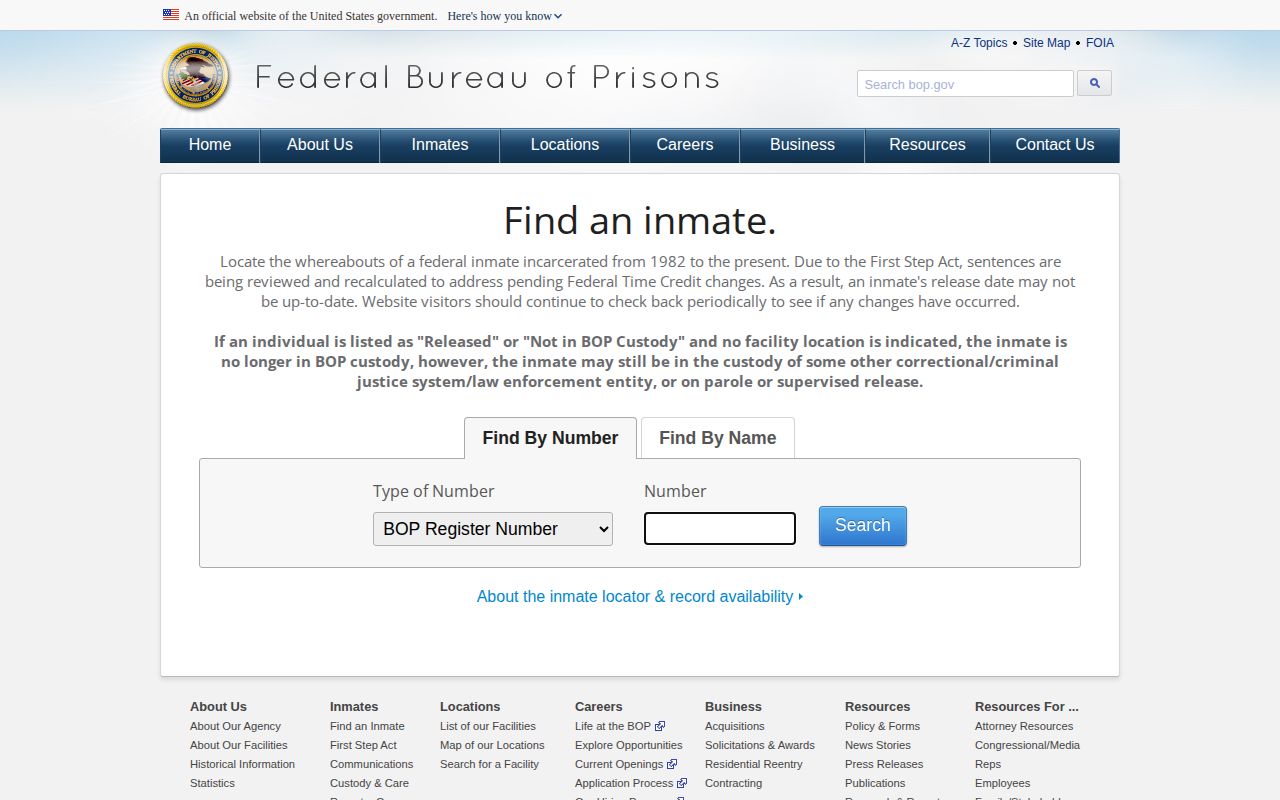
Use the exact identifier when available, then preserve the result’s date and location wording rather than expanding it into a broader claim.
- Choose the number search when a BOP, DCDC, FBI, or INS identifier is known. Otherwise, use the full federal name search.
- Compare the returned identity fields carefully. Do not merge records merely because two names resemble each other.
- Read the location or status and the release date exactly as BOP presents them.
- If the result says “Released” or “Not in BOP custody,” check the federal case and any known supervision or other hold.
- If the person appeared on the West Baton Rouge Parish roster, obtain the parish booking or transfer event to connect the local departure with the federal record.
Reading Federal Release Records
BOP’s records explanation states that post-1982 locator data update daily. A past release date paired with no institution or a released location means the person is no longer in BOP custody according to BOP’s own record. Daily updating still permits a lag, and it does not turn the locator into a live log of every handoff.
| Federal result | What it supports | What it does not settle |
|---|---|---|
| Current BOP institution | BOP reports present federal sentenced custody | Parish booking disposition or every court issue |
| Released with a date | Exit from BOP custody on the reported date | End of supervision or another sovereign’s custody |
| Not in BOP custody | BOP does not currently hold the person | Community release, immigration status, or no warrant |
| No locator match | No matching public BOP result was found | Proof that the person was never federally detained |
The federal judgment and docket supply sentence and court history. A BOP locator result supplies BOP custody scope. Neither replaces the West Baton Rouge Parish release-event record if the question is when the person physically left the parish jail. The West Baton Rouge Clerk criminal department is the local court-record route for the parish case.
Note: Record the exact BOP status and check date because federal locator information updates daily and may not reflect an immediate handoff.
USMS Detention Is Not BOP Release
The U.S. Marshals Service commonly holds and transports federal pretrial detainees. It does not offer a general public historical inmate locator equivalent to BOP’s. A person can therefore leave the West Baton Rouge Parish Detention Center in USMS custody and have no useful BOP result at that stage. The local event is a transfer under continued custody, not a release.
When the parish booking desk names USMS as the receiving agency, preserve that answer and locate the federal district case through PACER. The case docket can show detention orders, judgment, sentencing, and later court action. For custody details not shown publicly, use the appropriate USMS district or public-information route listed by the agency.
Federal Pretrial Custody Route
U.S. Marshals Service prisoner information
Federal case records: PACER or the responsible federal court
Historical public locator: none comparable to BOP
West Baton Rouge Federal Transfers
The West Baton Rouge Parish Detention Center serves parish law-enforcement agencies and also reports federal detainees among its population. That mixed role creates a common records problem: the same local roster change can mean bond release, sentence completion, movement to Louisiana DPS&C, or federal transfer. The local roster alone cannot name the outcome once the person disappears.
Call the booking desk at 225-346-6420 with the booking number when possible. Ask whether the booking closed, the recorded date and time of the event, its stated reason, and the receiving custodian if the event was a transfer. If the answer is federal, ask whether the named agency was BOP, USMS, or another federal authority. The West Baton Rouge Parish Detention Center page explains the local release-event and records route.
A court minute can support the legal basis for detention, bond, sentence, or dismissal, but it does not by itself prove the minute of physical departure or defeat another hold. Use the official owner of each fact: the sheriff for the parish event, the federal court for the judgment, BOP for BOP custody, and USMS for its detainee transport.
Note: The parish jail’s federal-detainee statement does not identify the responsible federal agency for any individual booking.
Federal Release Record Sources
A complete federal release inquiry may require several records because no single source owns the whole chain. Begin with the BOP locator for a sentenced person. Use BOP’s records explanation when interpreting an older released result. Obtain the federal judgment or docket when sentence language, supervision, or court action matters. If a parish jail event started the inquiry, request that booking and transfer entry from the Sheriff’s Office.
Federal Bureau of Prisons Network
Nationwide federal sentenced-custody system
BOP Inmate Locator
BOP locator records explanation
No BOP prison identified within West Baton Rouge Parish
Keep the request narrow. A federal identifier, case number, approximate custody dates, and the exact record sought are more useful than a broad request to explain everything that happened. If records conflict, the BOP custody file controls BOP status, while the signed federal order controls the court’s sentence.
Preserve the source and date for each fact. Booking date, federal detention date, judgment date, BOP release date, supervision start, and supervision end are separate fields. A person can move from parish custody to USMS, enter BOP after sentencing, and later leave BOP under supervision. Compressing that sequence into one unlabeled “release date” would erase the legal handoffs that determine where the next record belongs.
If the local and federal sources appear to disagree, ask each owner about its own event. The West Baton Rouge Parish Sheriff’s Office can confirm the parish booking or transfer. The federal court can provide the order. BOP can explain its custody record. This division is more reliable than asking one office to interpret every agency’s file.
After a Federal BOP Release
Release from BOP custody may be followed by federal supervised release, community confinement, or custody under another authority. The public locator is not a complete supervision database. The judgment and the responsible federal supervision office are the proper sources for any continuing federal conditions.
Another sovereign can also act at the point BOP custody ends. A state warrant may produce a state transfer. An immigration detainer may lead to immigration custody, which must be checked through ICE rather than inferred from BOP’s released label. These are sequential events. Reporting the BOP date accurately does not authorize a claim that the person was unrestricted afterward.
For personal verification, record the BOP status, reported release date, date the locator was checked, and the identifier used. Then check only the additional official source that matches the known issue. This avoids turning a valid but narrow federal result into an unsupported statement about every possible restraint.
A no-match result deserves the same restraint. It may reflect spelling, incomplete identifying details, the limits of the post-1982 database, or custody outside BOP. It does not establish release and does not identify USMS pretrial status. Retry with a known federal number, compare name variants carefully, and move to the federal docket or responsible agency when BOP is not the custodian.
Note: A past BOP release date should remain labeled as BOP custody information, not a universal end date for all supervision.
Federal Network Serving the Parish
The Federal Bureau of Prisons Network is included in the West Baton Rouge Parish facility map as a custody system, not as a local building. The official sweep found no dedicated federal prison within the parish. A person’s connection to West Baton Rouge can arise because the parish jail temporarily housed a federal detainee before a federal transfer.
That connection must be proven from the individual records. The parish’s general statement that it houses federal detainees does not establish a BOP sentence, an ICE contract, or a USMS transfer for any specific person. Classify the custody, use the matching official channel, and never treat a missing parish or BOP result as affirmative proof of release.
The broader West Baton Rouge Parish release search sets out the state, parish, federal, and immigration branches when the legal custodian is not yet clear.